Polymarket Trading Bot: How to Automate Your Edge on Prediction Markets
Learn how a Polymarket trading bot works, what automation is available without code, and how Bravado gives traders and developers the infrastructure to trade systematically.
Between April 2024 and April 2025, arbitrage traders earned over $40 million on Polymarket. Every dollar of that came from speed and automation that manual traders could not match. Bots were monitoring hundreds of markets simultaneously, executing orders in milliseconds, and managing risk automatically around the clock.
Manual trading on Polymarket is increasingly a disadvantage. Markets move fast. Whale signals surface and disappear in minutes. Limit orders fill while you are not watching. The traders extracting consistent edge are the ones who have removed themselves from the execution layer entirely.
This post covers what a Polymarket trading bot actually does, what automation is available without writing a single line of code, and what the infrastructure looks like for developers who want to build on top of the platform.
What a Polymarket Trading Bot Does
A trading bot is any system that monitors market conditions and executes orders automatically based on predefined rules. On Polymarket, that means connecting to the CLOB (Central Limit Order Book) API, reading live orderbook data via WebSocket, and placing, modifying, or cancelling orders programmatically.
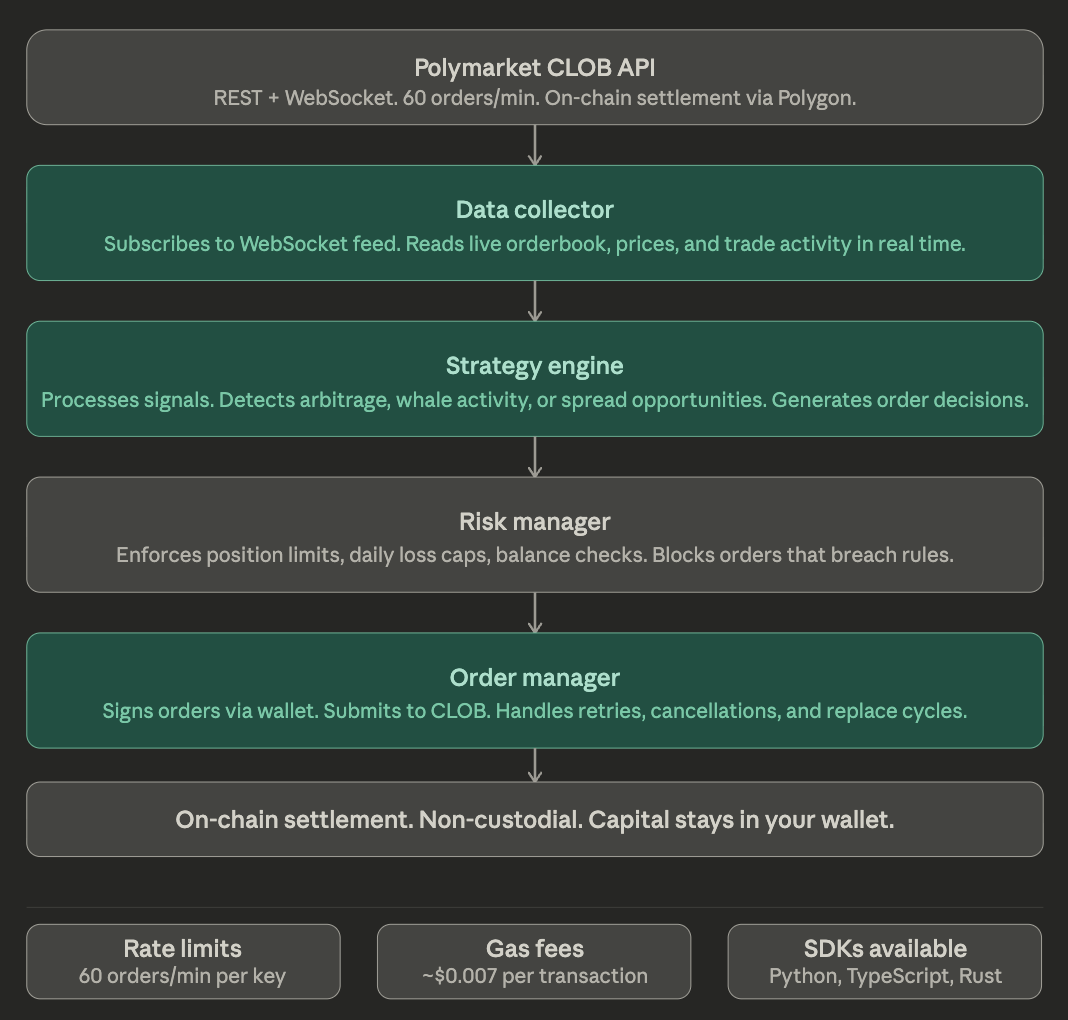
Polymarket's CLOB API supports up to 60 orders per minute per API key, with public data endpoints capped at 100 requests per minute. Orders are signed by your wallet, submitted to the CLOB, and settled on-chain on Polygon. Your capital stays non-custodial throughout.
The four things bots do better than manual traders are speed, consistency, monitoring scale, and risk enforcement. A bot can watch 200 markets simultaneously, fire an order within milliseconds of a signal, replace a filled limit order before the next block, and enforce position limits that a manual trader would override in the heat of the moment.
The catch is that building and maintaining a production-ready bot requires real infrastructure. A low-latency VPS, API credential management, order retry logic, WebSocket reconnection handling, and a risk layer that enforces limits before orders hit the API. With Polygon gas fees averaging around $0.007 per transaction, infrastructure costs typically outweigh transaction fees, making the quality of your execution setup a meaningful variable in profitability.
For most traders, that is more friction than the edge justifies. Which is why the right answer is often not to build a bot, but to use one.
Automation Without Code: What Bravado Gives You
Bravado's trading terminal gives non-technical traders access to the same execution automation that bots provide, without any infrastructure overhead.
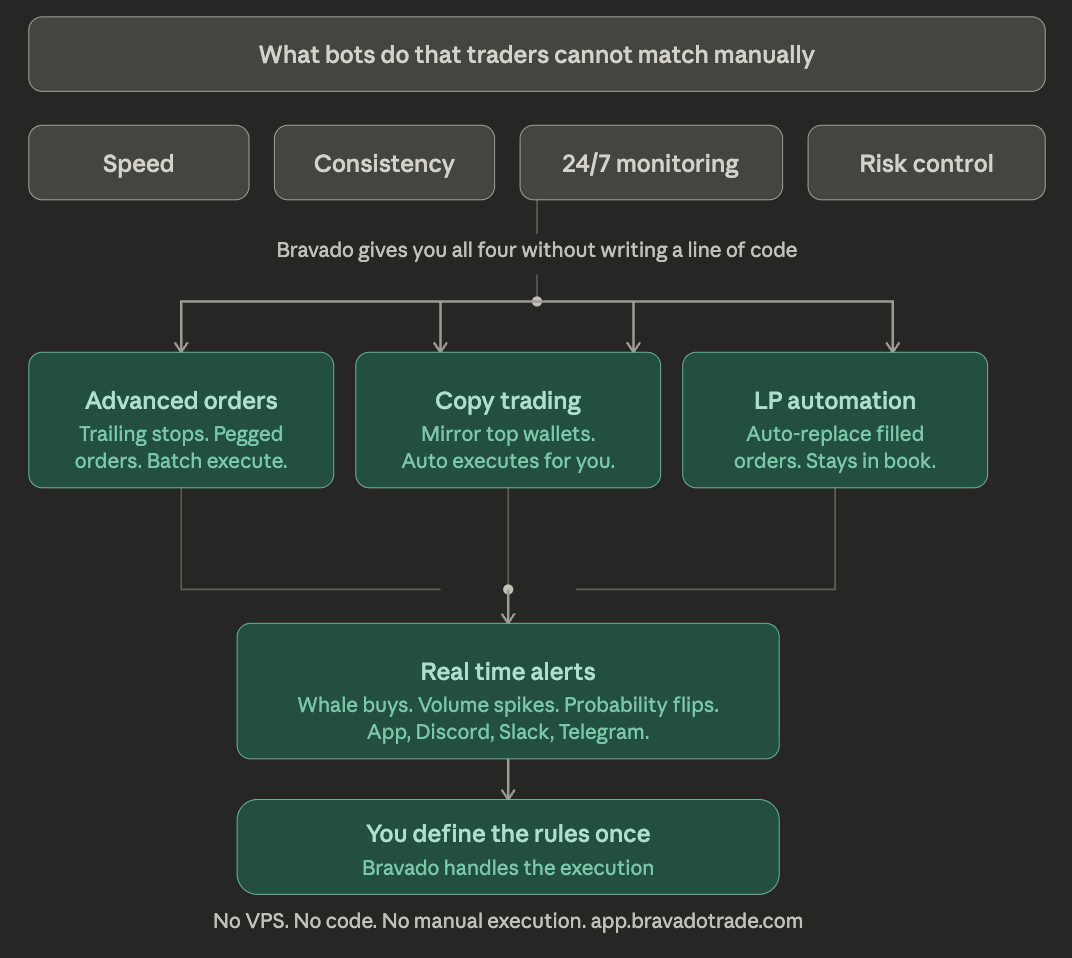
Advanced order types as automation. Trailing stop loss orders adjust automatically as a market moves in your favor and execute the moment it reverses by your configured threshold. Top-of-book pegged orders reprice continuously to stay at the front of the queue without manual adjustment. Batch orders execute across multiple markets in a single action. These are not manual orders you place and watch. They are rules you define once that execute automatically.
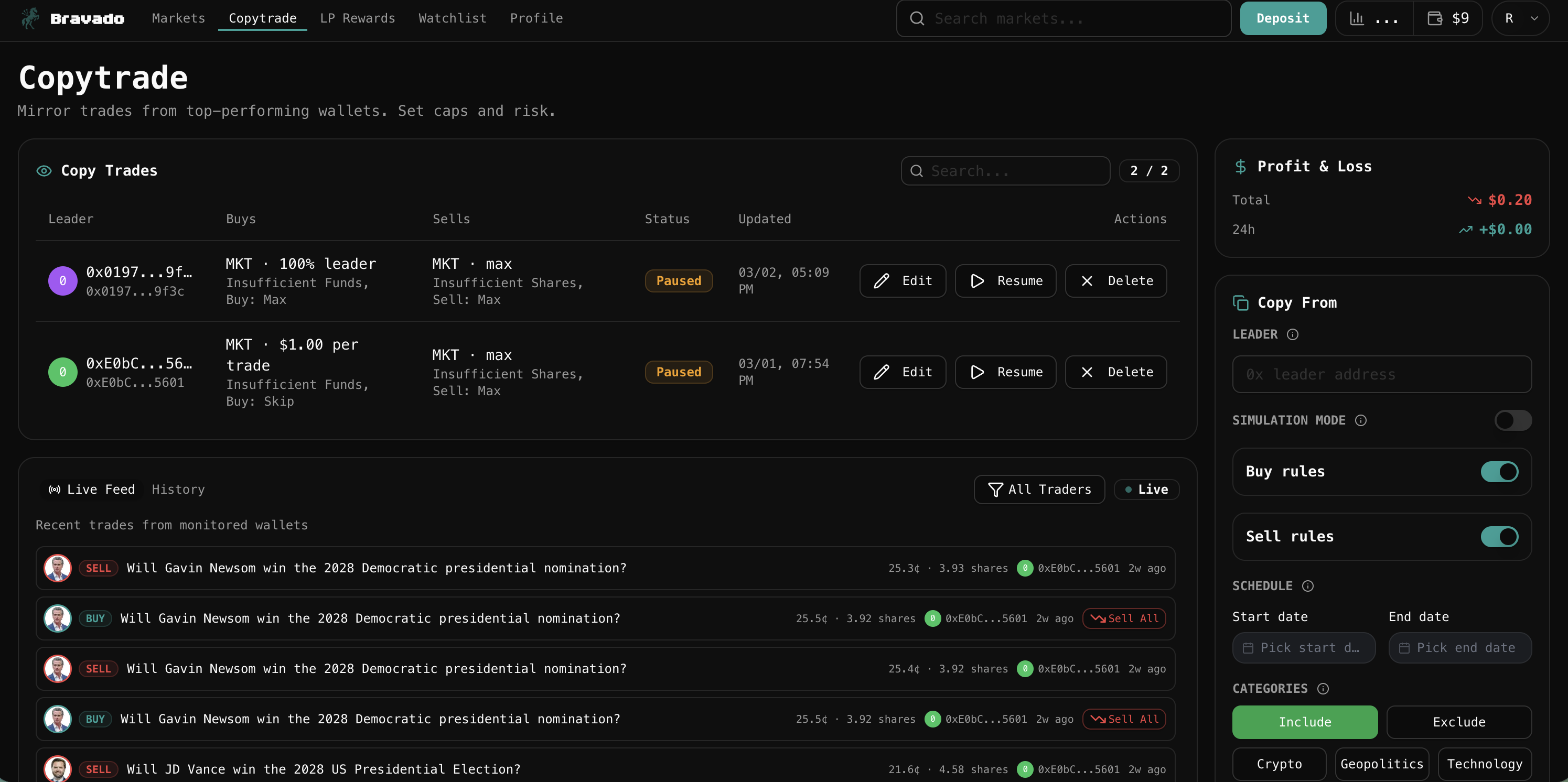
Copy trading as a systematic strategy. Bravado's copy trading feature is functionally a bot for following smart money. Define the wallets you want to mirror, set your sizing parameters, and Bravado executes the same positions automatically the moment those wallets enter a market. You are not placing orders manually. The system is.
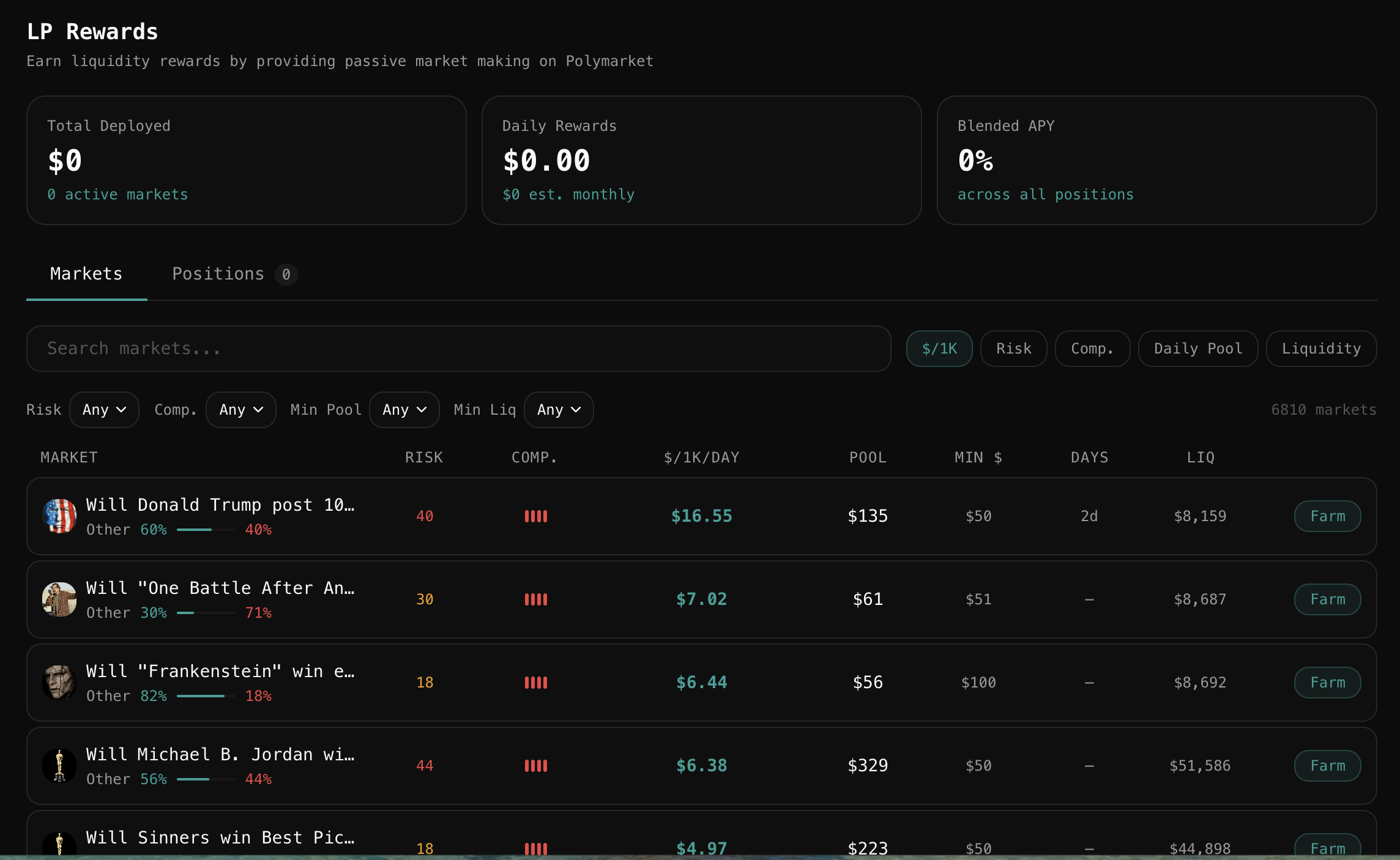
LP farming automation. Bravado's LP farming tools handle the most repetitive bot-like task in prediction market trading: replacing filled limit orders continuously to maintain book presence. Auto-replace detects a fill and places a replacement immediately, maintaining your reward share without any manual step.
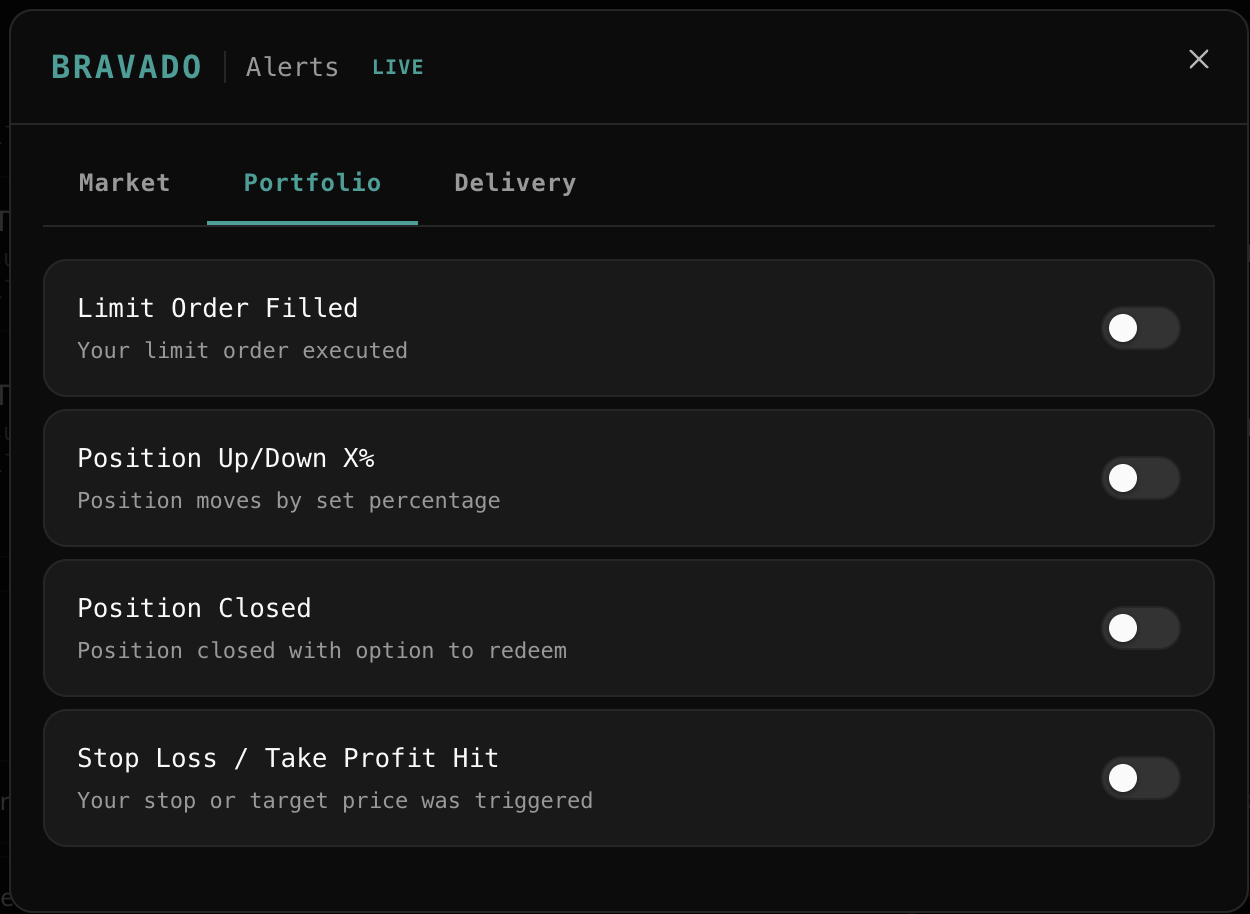
Real time alerts as triggers. Rather than a bot that acts autonomously, some traders prefer to be the decision layer with automated monitoring doing the detection. Bravado's alerts system surfaces whale buys, volume spikes, probability flips, and portfolio events in real time via app, Discord, Slack, or Telegram. You get the signal instantly. You decide whether to act.
For the majority of active Polymarket traders, these four tools together replace the need to build or run a custom bot.
For Developers: Building on Polymarket's CLOB
For developers who want to build custom automation, Polymarket's API stack is well documented and actively maintained.
The CLOB API handles order placement, cancellation, and orderbook data via both REST and WebSocket. Official client libraries are available in Python, TypeScript, and Rust, with the TypeScript client being the most actively used in the developer community. The Gamma API provides market metadata, event data, and pricing. The Data API covers holder positions, trade history, and leaderboard data.
A production bot architecture typically follows four modules. A data collector subscribing to the WebSocket feed for real time orderbook and trade data. A strategy engine processing signals and generating order decisions. An order manager handling signing, submission, and retry logic against the CLOB. And a risk manager enforcing position limits, daily loss caps, and balance checks before any order reaches the API.
Bravado is built on this same infrastructure. For developers who want a base layer rather than building everything from scratch, the terminal's execution infrastructure, order type logic, and market data integrations are available via API access. It is a faster path to production than building the full stack independently.
Start Automating Your Polymarket Trading
Whether you want to automate without code or build custom strategies on top of the CLOB, Bravado is the infrastructure layer for serious Polymarket participants.
Explore the full terminal at app.bravadotrade.com
Follow us on X for automation strategies, product updates, and market insights: @bravadotrade