Polymarket Combos, Two Months In
Polymarket combo markets analyzed: $212.6M in volume, 757K trades, and a stark win-rate gap between whales and retail. Full on-chain breakdown.

Polymarket's combinatorial markets, parlay-style contracts that bundle several outcomes into a single token, went live on May 27, 2026. Two months later, we pulled every fill, redemption, and abandoned position straight off Polygon to see what actually happened.
The short version: combos took off fast, the money is brutally concentrated in a small number of wallets, and the retail experience looks a lot like buying lottery tickets.

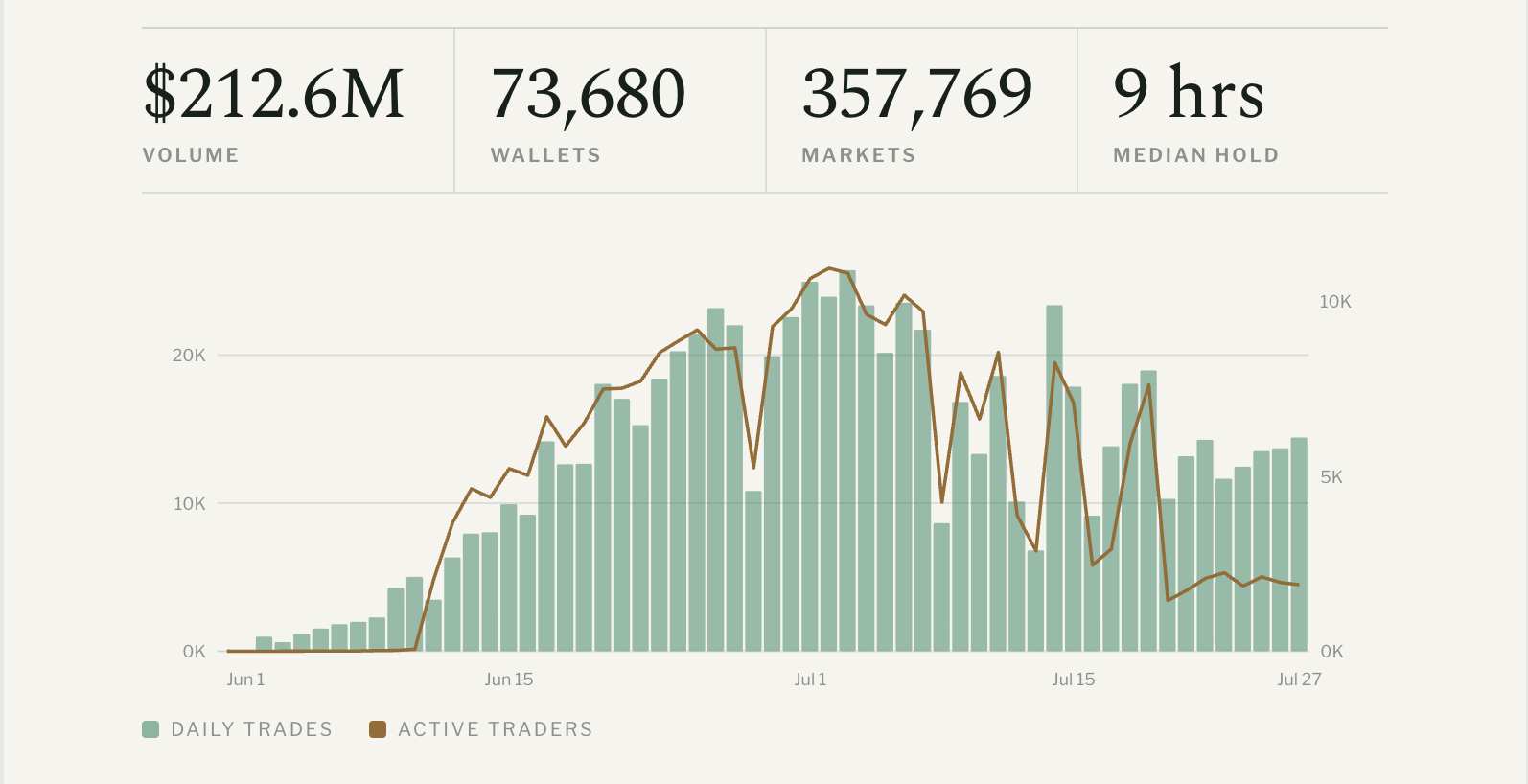
From zero to 25,000 trades a day in five weeks
Combos didn't start as a retail product. The first two weeks were quiet, carried almost entirely by a handful of market makers seeding books. Retail showed up in force by mid-June, and daily activity peaked on July 3 at nearly 26,000 trades from close to 11,000 active wallets in a single day.
Since then, the crowd has thinned. The final week of our sample settled into a steadier rhythm: roughly 13,000 trades a day from about 2,000 active wallets, activity now driven more by regulars and the sports calendar than by novelty.
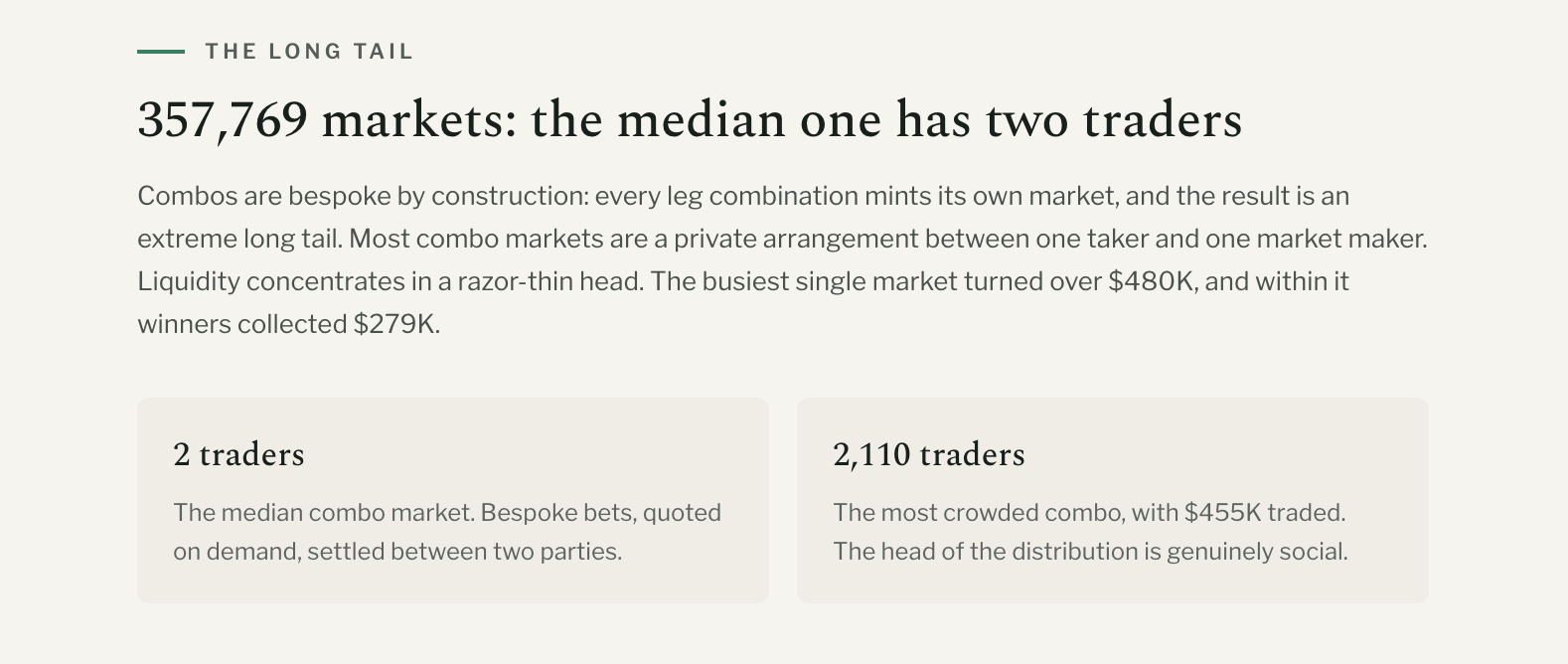
357,769 markets, and the median one has two traders
Because every leg combination mints its own market, combos produce an extreme long tail. Most of these markets are really a private arrangement between one taker and one market maker, quoted on demand, settled between two parties, never touched by anyone else.
Liquidity concentrates in a razor-thin head. The single busiest combo market turned over $455K across 2,110 traders, genuinely social, in a sea of markets that are anything but.
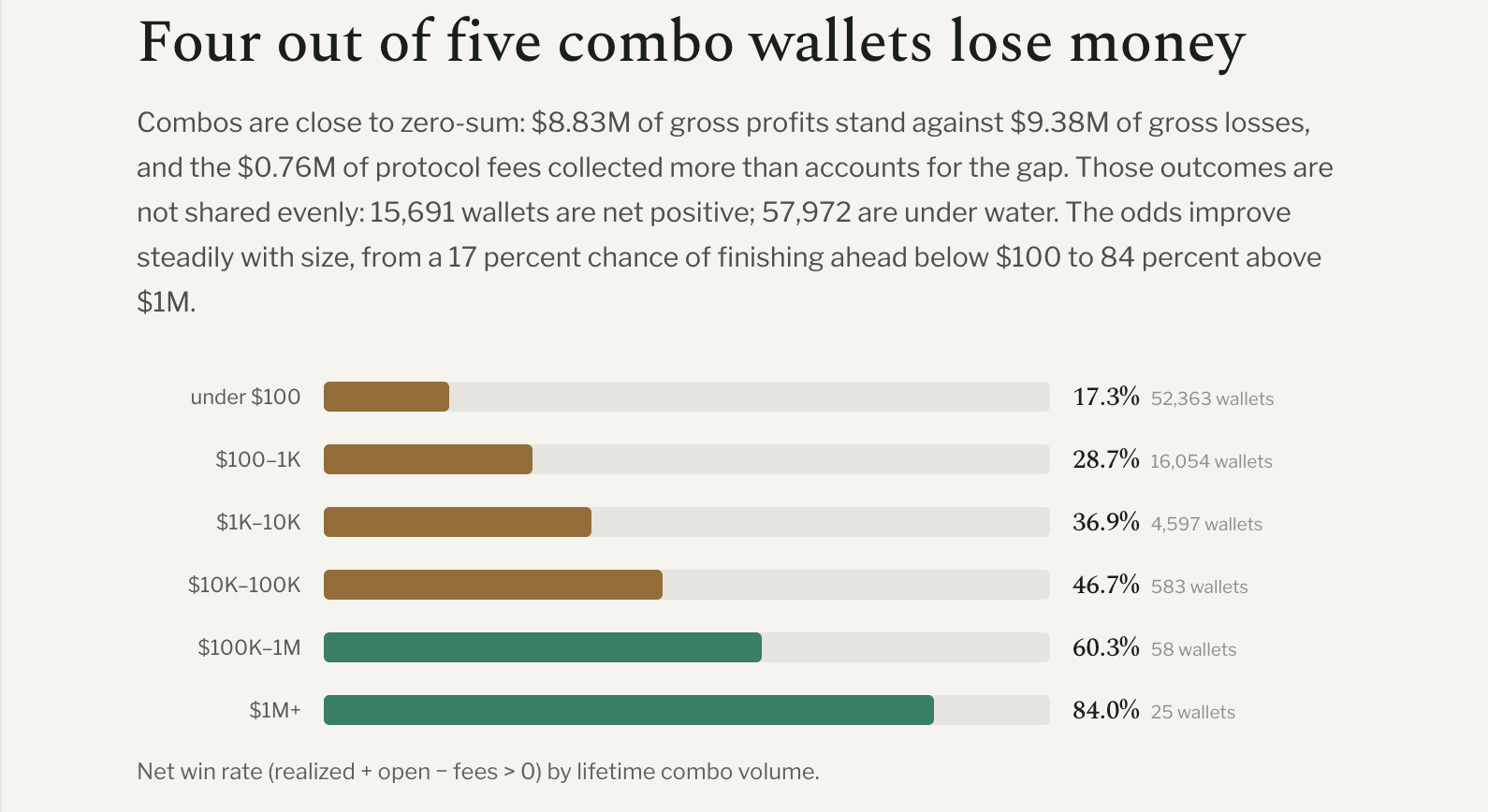
Four out of five combo wallets lose money
This is the number that matters most. Combos are close to zero-sum by design: $8.83M in gross profits sit against $9.38M in gross losses, with the $0.76M gap explained almost exactly by protocol fees. But those outcomes are not shared evenly. 15,691 wallets finished net positive, while 57,972 went underwater.
The odds get dramatically better with size:
Under $100 lifetime volume: 17.3% win rate (52,363 wallets)
$100 to $1K: 28.7% (16,054 wallets)
$1K to $10K: 36.9% (4,597 wallets)
$10K to $100K: 46.7% (583 wallets)
$100K to $1M: 60.3% (58 wallets)
$1M+: 84.0% (25 wallets)
That's not a subtle gradient. It's a five-fold jump in win probability from the smallest bucket to the largest. Combos reward scale, information, and repetition. They punish the casual, one-off bettor almost by construction.
100 wallets move 85% of the money
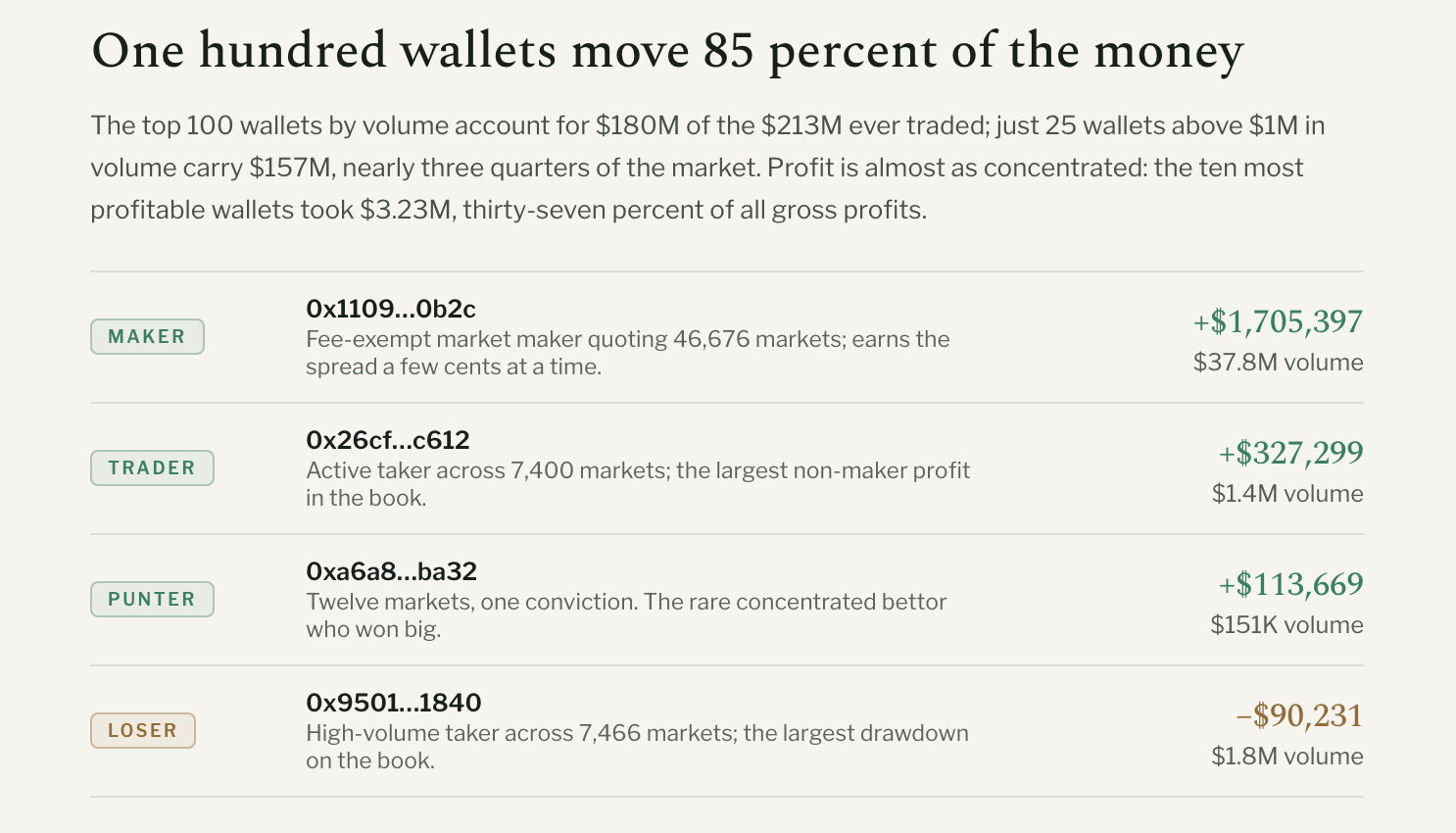
The top 100 wallets by volume account for $180M of the $213M ever traded. Just 25 wallets with over $1M in lifetime volume carry $157M, nearly three-quarters of the entire market. Profit concentration tracks closely: the ten most profitable wallets alone captured $3.23M, 37% of all gross profits.
The archetypes are distinct and worth naming:
The Maker: a fee-exempt market maker quoting 46,676 markets, earning the spread a few cents at a time, netting +$1.7M on $37.8M of volume.
The Trader: an active taker across 7,400 markets, the largest non-maker profit in the book at +$327K.
The Punter: twelve markets, one conviction, +$113,669. The rare concentrated bettor who won big.
The Loser: a high-volume taker across 7,466 markets, the largest drawdown on the book at -$90,231.
Winners collect. Losers walk away.
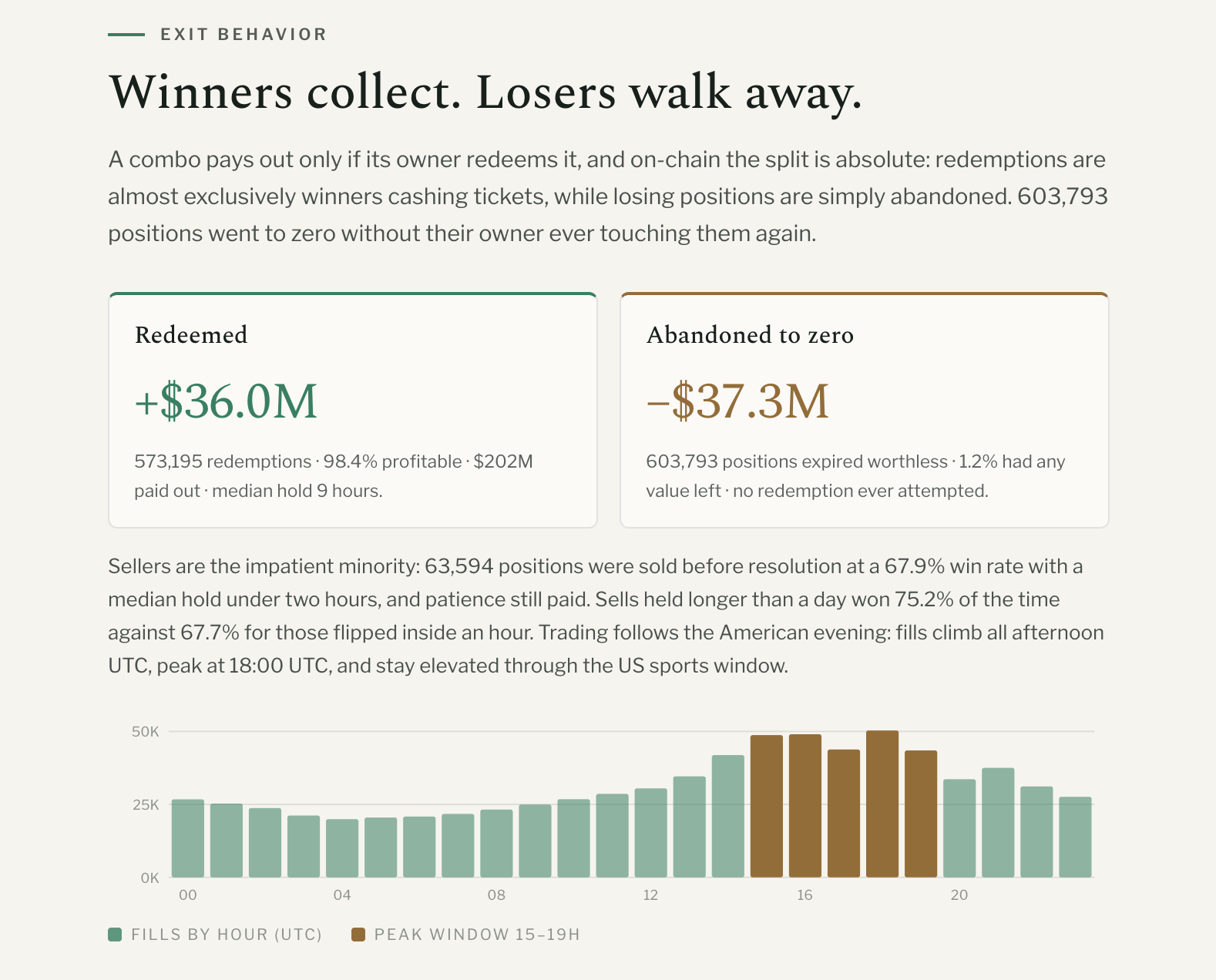
A combo only pays out if its owner actively redeems it, and on-chain, the split between winners and losers is almost absolute. Redemptions are overwhelmingly winners cashing tickets: 573,195 redemptions, 98.4% profitable, $202M paid out, with a median hold of 9 hours.
Losing positions, by contrast, are simply abandoned. 603,793 positions expired worthless without their owner ever touching them again. Only 1.2% of those had any residual value, and none were ever redeemed.
Sellers who exit before resolution are the impatient minority: 63,594 positions, a 67.9% win rate, median hold under two hours. And patience pays even there: positions held longer than a day before selling won 75.2% of the time, versus 67.7% for same-hour flips.
Trading follows the American evening almost exactly. Fills climb through the afternoon UTC, peak at 18:00 UTC, and stay elevated through the US sports window.
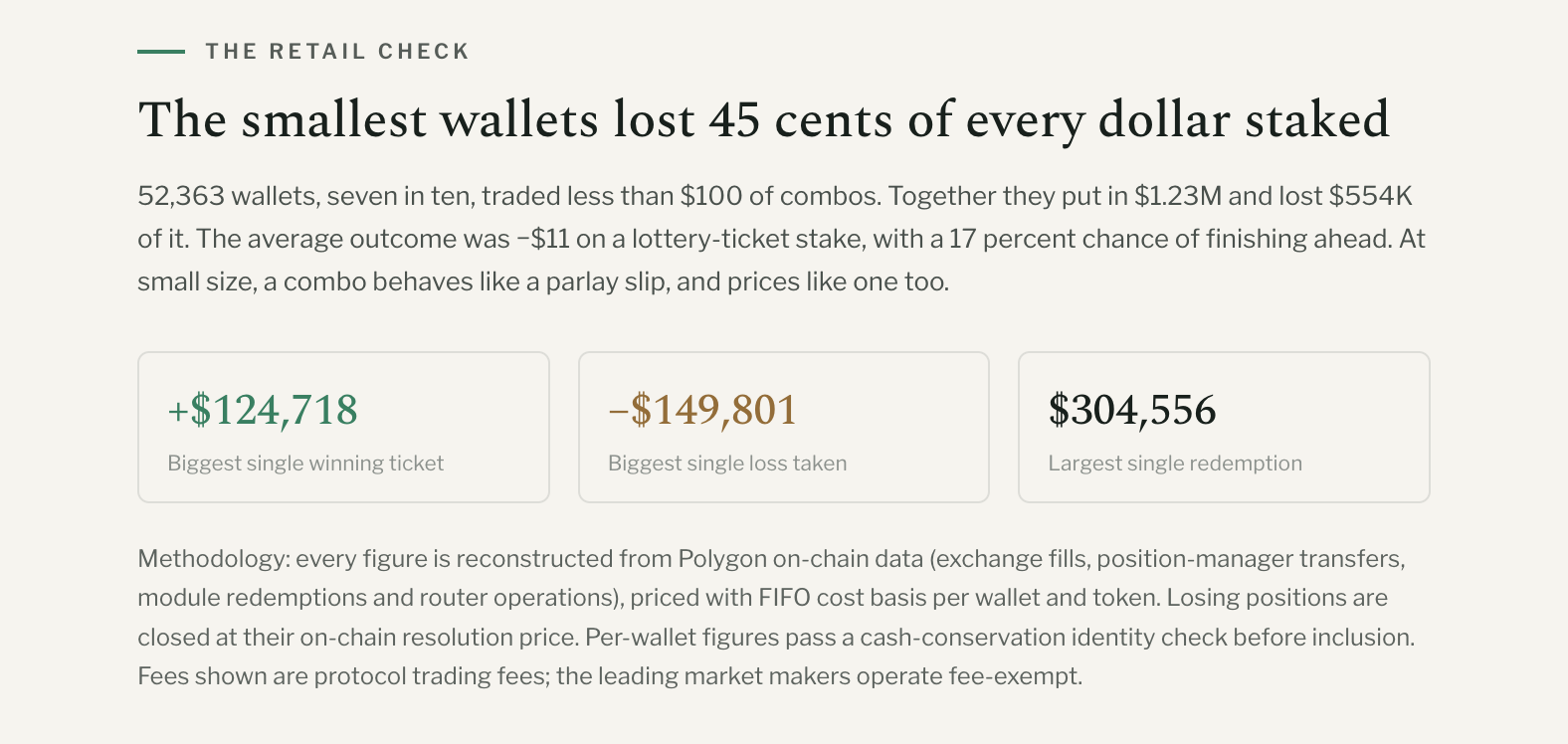
The smallest wallets lost 45 cents of every dollar staked
52,363 wallets, seven in ten of everyone who touched combos, traded less than $100 total. Together they put in $1.23M and lost $554K of it. The average outcome on that segment was -$11 per wallet, with a 17% chance of finishing ahead.
At small size, a combo behaves exactly like a parlay slip, and it prices like one too.