Polymarket Agents: How AI Agents Are Trading Prediction Markets in 2026
Polymarket agents explained: how AI trading agents work, what infrastructure they need, and how to build your own with data, execution, and copytrading APIs.
"Polymarket agents" has become one of the fastest growing search terms in the space, and for good reason. What started as a handful of hobbyist scripts has turned into a real share of platform activity. Reporting from CoinDesk in March 2026 pointed to autonomous agents like Olas's Polystrat, which executed over 4,200 trades on Polymarket in its first month, as evidence that AI driven trading is no longer a fringe experiment. Industry estimates now put AI and algorithmic wallets at roughly a third of all Polymarket activity. If you're trying to understand what a Polymarket agent actually is and what it takes to build one, here's the real picture.
What "Polymarket Agent" Actually Means
The term gets used loosely, so it's worth separating two things that look similar but aren't.
A scripted trading bot follows fixed rules. Buy when a price crosses a threshold, close a position at a set profit target, arbitrage between two correlated markets. The logic is hardcoded and doesn't reason about anything, it just executes conditions.
A Polymarket agent, in the sense the term is used today, is something closer to an autonomous researcher that happens to trade. It reads news, market context, and price history, forms a view using an LLM, and then acts on that view by placing an order, all without a human approving each step. Polymarket itself published an open source framework for exactly this pattern, standardizing how an LLM ingests market data and news to inform trading decisions, though that particular project has since gone dormant as third party frameworks like Olas's have taken over as the more actively maintained approach.
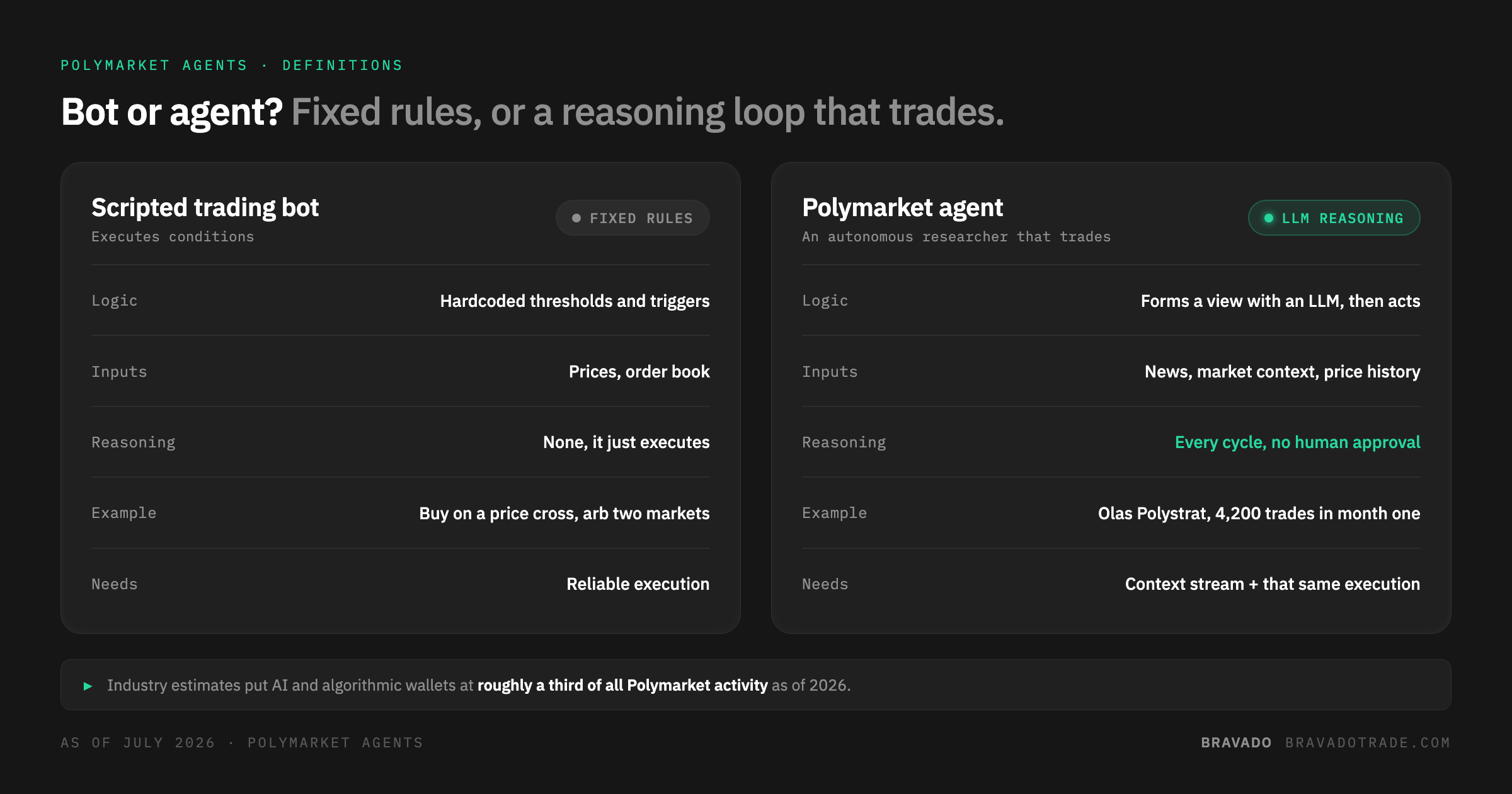
This distinction matters because the two require completely different infrastructure. A scripted bot just needs reliable execution. An agent needs a constant stream of context to reason over, on top of that same execution layer.
The Building Blocks Every Agent Needs
Whether you're using an existing framework or building your own from scratch, every Polymarket agent needs the same four pieces underneath it.
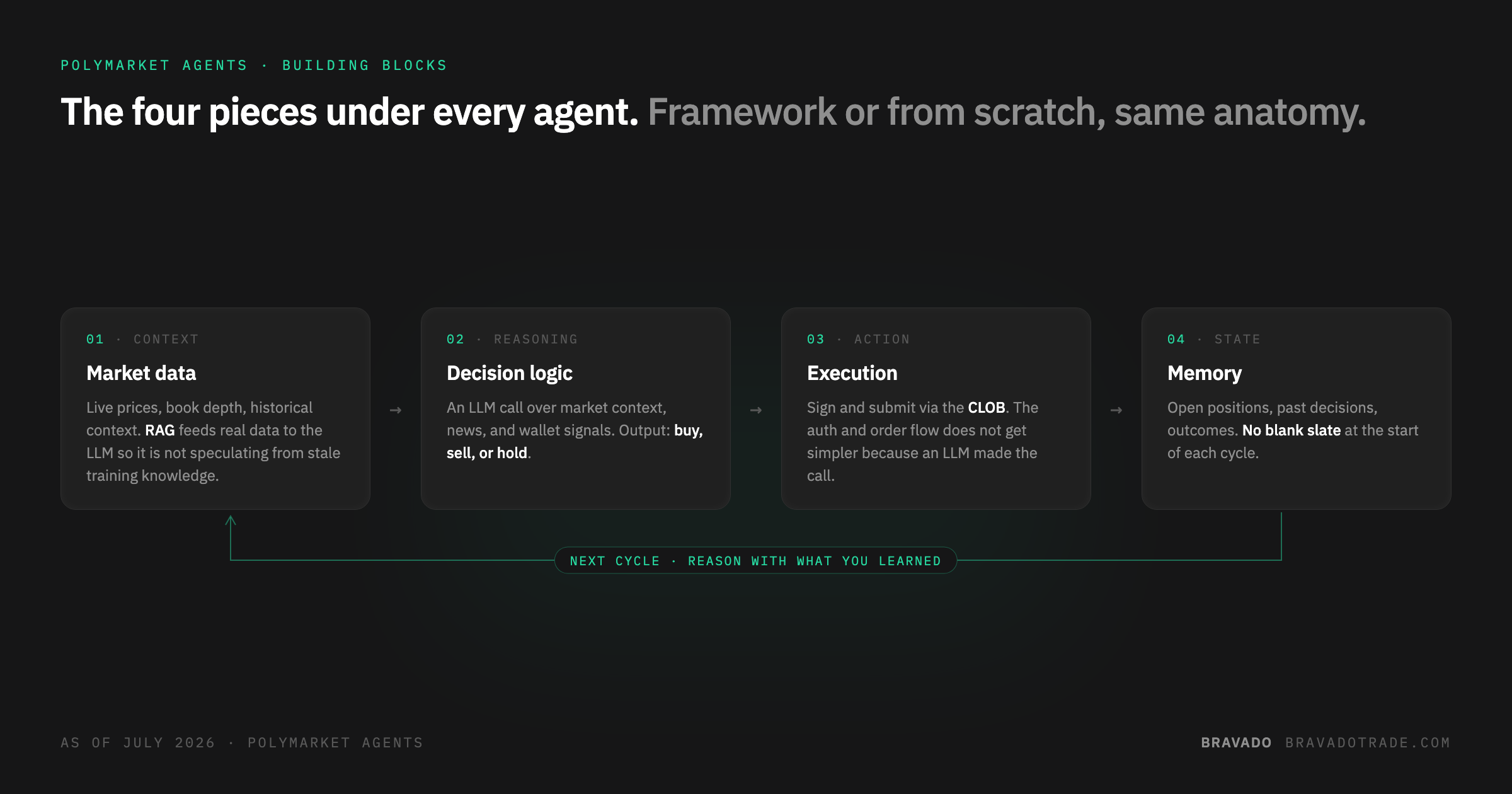
Market data. The agent needs live prices, order book depth, and enough historical context to ground its reasoning. This is also where Retrieval Augmented Generation typically comes in, feeding real market data to the LLM rather than letting it speculate from training knowledge alone, which is unreliable for anything time sensitive like an election or an economic release.
Decision logic. The actual reasoning step, usually an LLM call with the market context, relevant news, and sometimes the behavior of other successful wallets fed in as input, producing a decision to buy, sell, or hold.
Execution. Turning that decision into a signed, submitted order. This is the same authentication and order flow covered in Polymarket's CLOB API, and it doesn't get any simpler just because an LLM made the decision instead of a human.
Memory and state. Tracking open positions, past decisions, and outcomes so the agent isn't reasoning from scratch every cycle with no sense of what it already did.
Why Infrastructure Matters More Than the Model
Most of the writing on Polymarket agents focuses on the reasoning layer, prompt design, which LLM to use, how to structure the research step. That part matters, but it's not usually where things break in practice. An agent is only as good as the data it's reasoning over and the execution behind its decisions. A brilliant trading thesis built on stale or rate limited data, or an order that gets submitted slowly against a moving market, loses to a mediocre thesis backed by clean infrastructure.
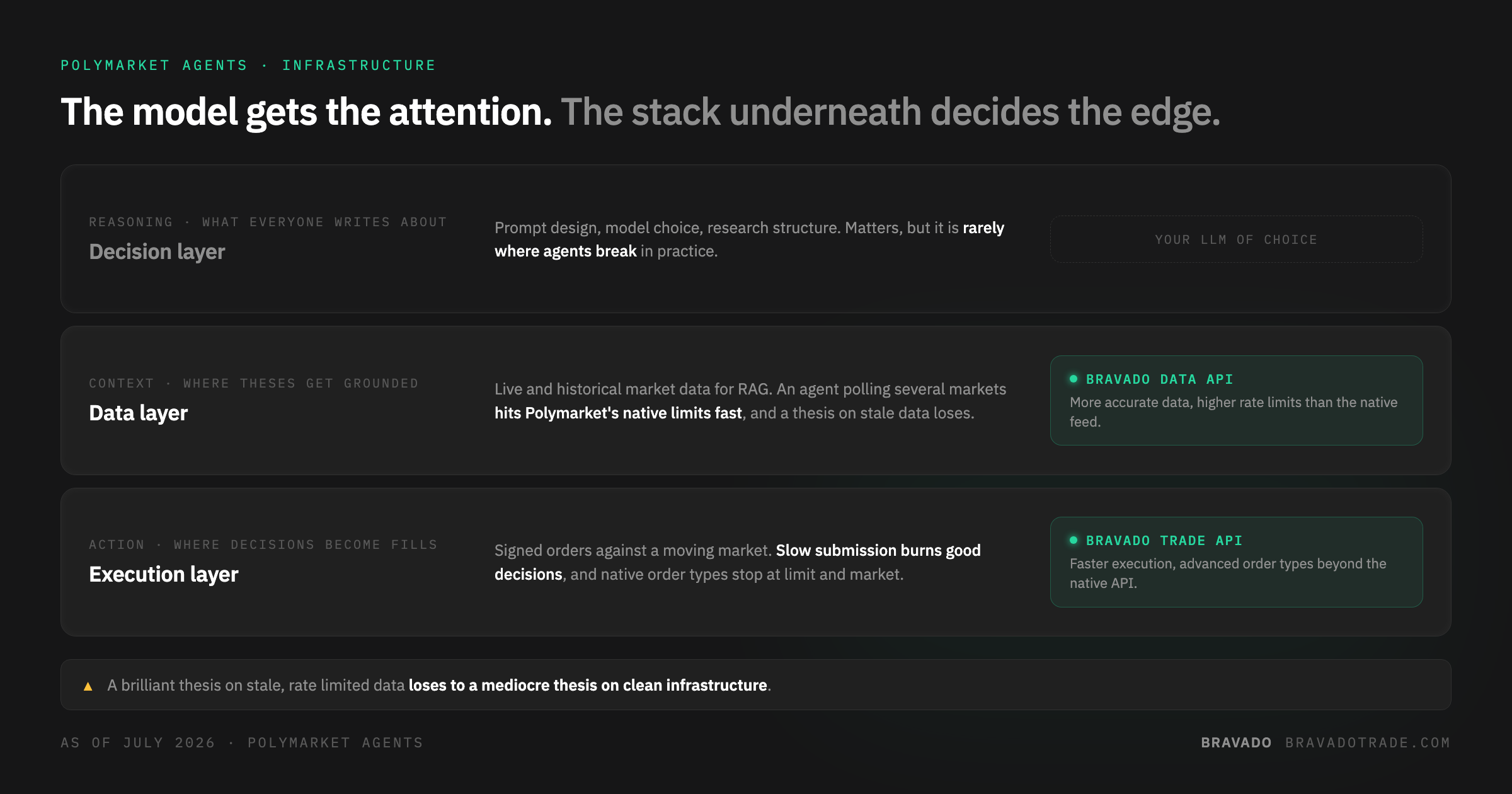
This is exactly why the data and execution layer underneath an agent deserves as much attention as the agent's logic itself. Bravado's Data API gives an agent more accurate market data with higher rate limits than Polymarket's native feed, which matters directly here since an agent polling several markets for context, or backfilling history to ground its reasoning, will hit Polymarket's native limits fast. And once the agent has decided to act, Bravado's Trade API offers faster execution and advanced order types beyond Polymarket's basic limit and market orders, which becomes more valuable the more sophisticated the agent's decision logic gets.
Copytrading Is the Simplest Agent Pattern There Is
Strip away the LLM reasoning and news ingestion, and one of the most common agent patterns in the wild right now is genuinely simple: watch a specific wallet, and mirror what it does. Reporting on the current Polymarket bot landscape has noted that a meaningful share of the most profitable accounts are already automated, and copying a proven wallet's behavior is a far lower lift than building original research logic from scratch.
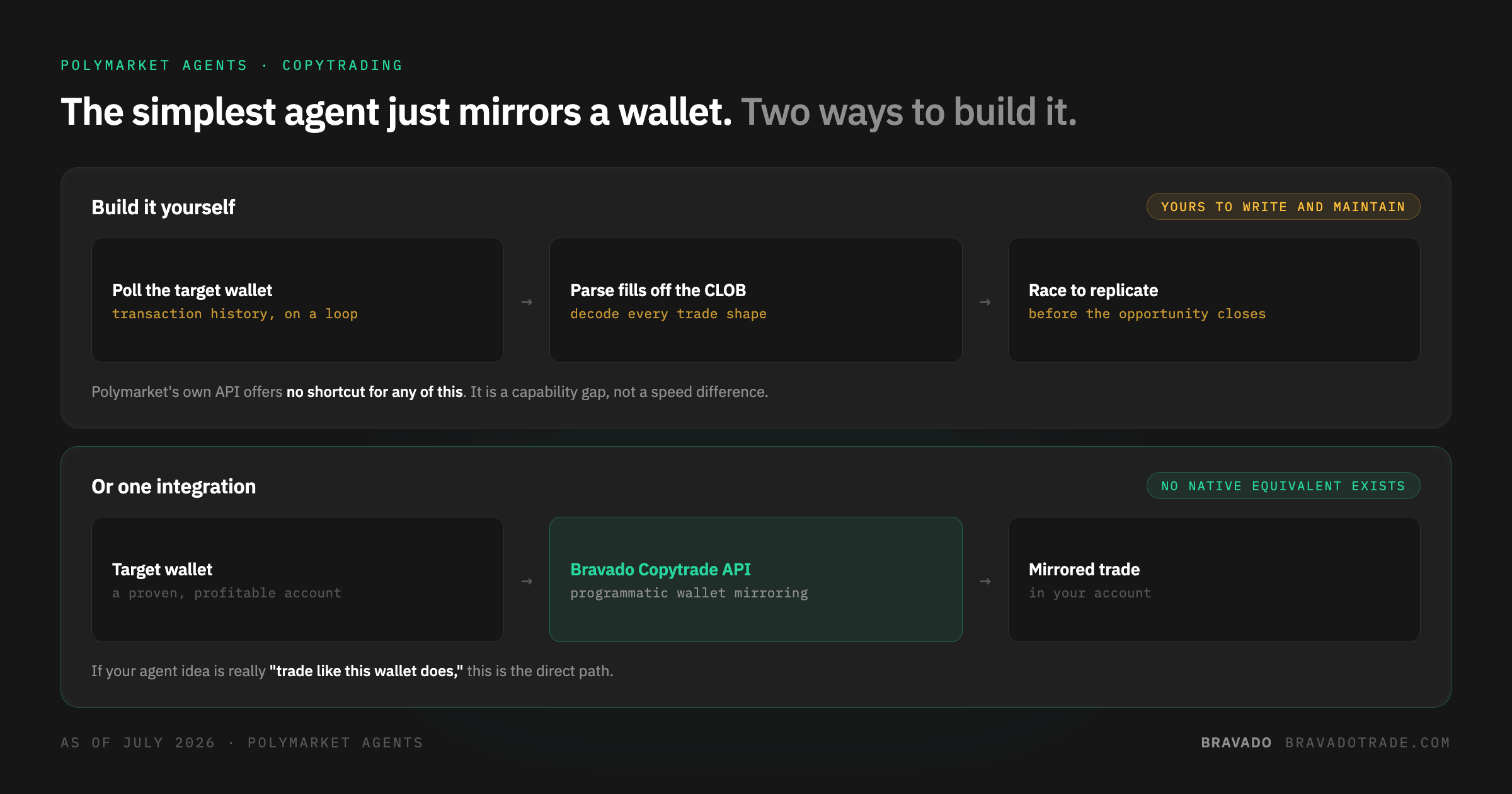
The catch is that Polymarket's own API gives you no shortcut for this. You'd be polling a target wallet's transaction history, parsing fills, and racing to replicate the trade before the opportunity closes, all logic you'd have to write and maintain yourself. Bravado's Copytrade API exists because this is a capability Polymarket has no native equivalent for at all, not a faster version of something that already exists. If your "agent" idea is really just "trade like this wallet does," this is the more direct path to it.
Building Your Own Agent: A Practical Starting Point
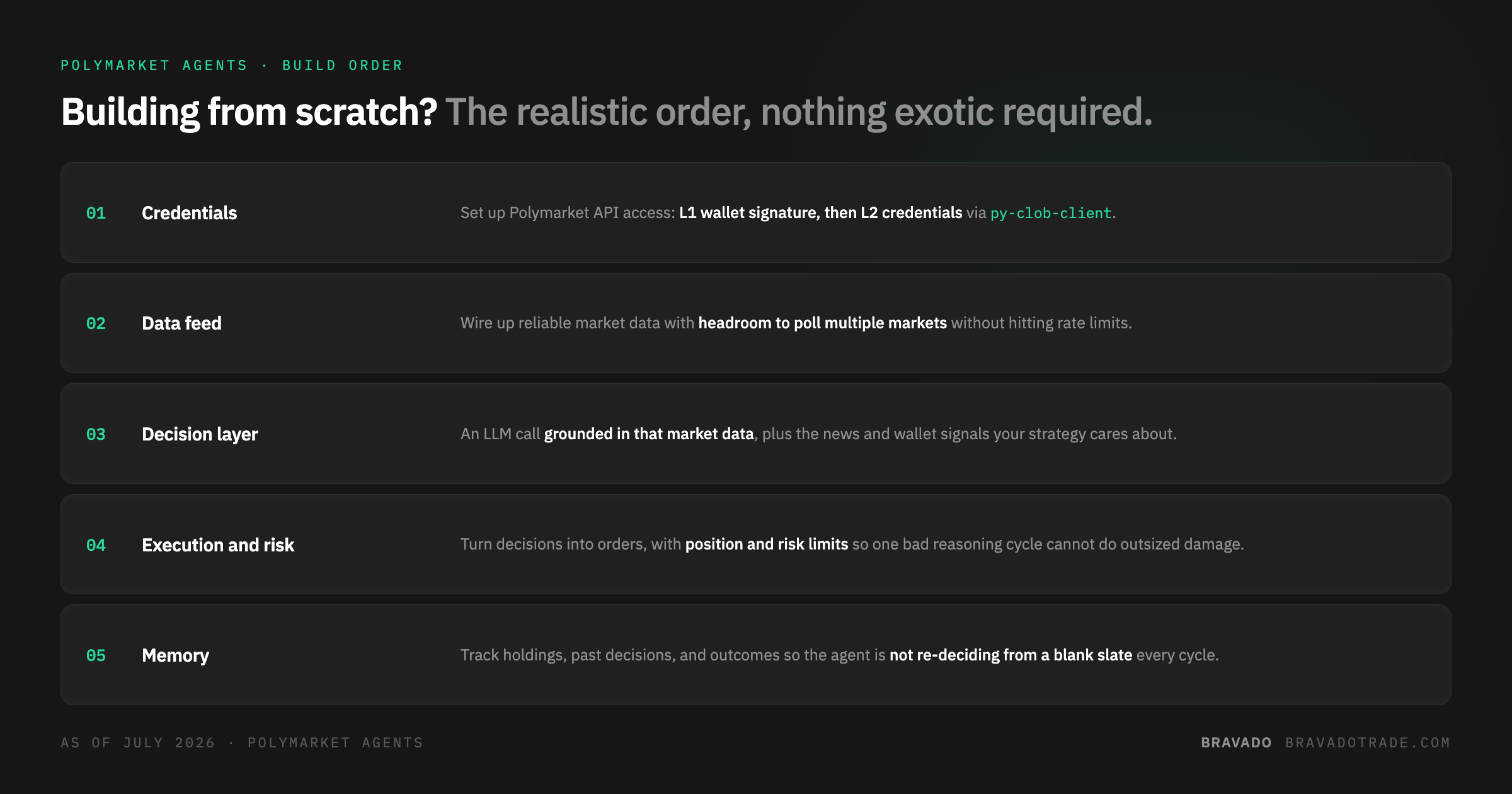
If you're building from scratch rather than adopting an existing framework, the realistic build order looks like this:
Get your Polymarket API credentials set up (see our API key and trading bot guide for the full authentication walkthrough)
Wire up a reliable data feed for the markets you care about, ideally with enough headroom to poll multiple markets without hitting rate limits
Build or plug in your decision layer, an LLM call grounded in that market data plus whatever news or wallet signals matter to your strategy
Connect execution so decisions actually turn into orders, with basic position and risk limits so a bad reasoning cycle can't do outsized damage
Add memory so the agent tracks what it already holds and did, rather than re-deciding from a blank slate every cycle
None of this requires exotic infrastructure. It requires the same data and execution layer any serious Polymarket bot needs, just wrapped around an LLM instead of fixed rules. The agent's intelligence is the part everyone talks about. The data and execution underneath it is the part that actually determines whether that intelligence turns into a real edge.
This article reflects the public state of AI trading agents on Polymarket as of July 2026. This space is moving quickly and specific frameworks and tools referenced here may change.