Is Polymarket Legal in the US? The Complete 2026 Guide
Is Polymarket legal in the US? Complete 2026 guide to CFTC rules, state-by-state status, VPN risks, and country restrictions for Polymarket traders.
Is Polymarket Legal in the US? The Complete 2026 Guide
Polymarket's legal status is one of the most confused topics in prediction markets right now, and for good reason. There are two separate products sharing the Polymarket name, a multi year regulatory saga with the CFTC, and an active fight between federal regulators and individual states that has not been resolved. This guide breaks down exactly where things stand, state by state, so you are not relying on outdated search results from three different phases of this story.
The Quick Answer
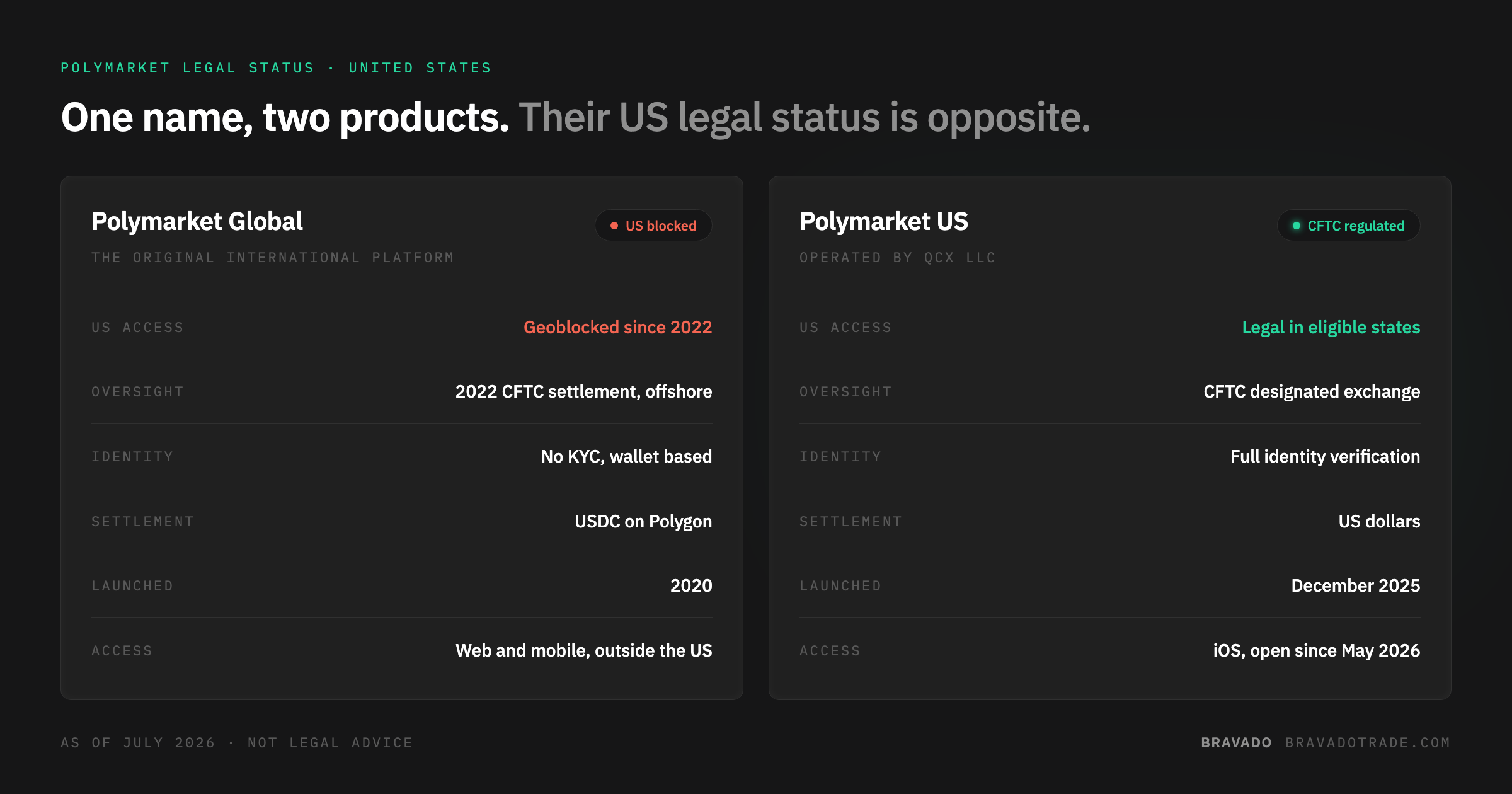
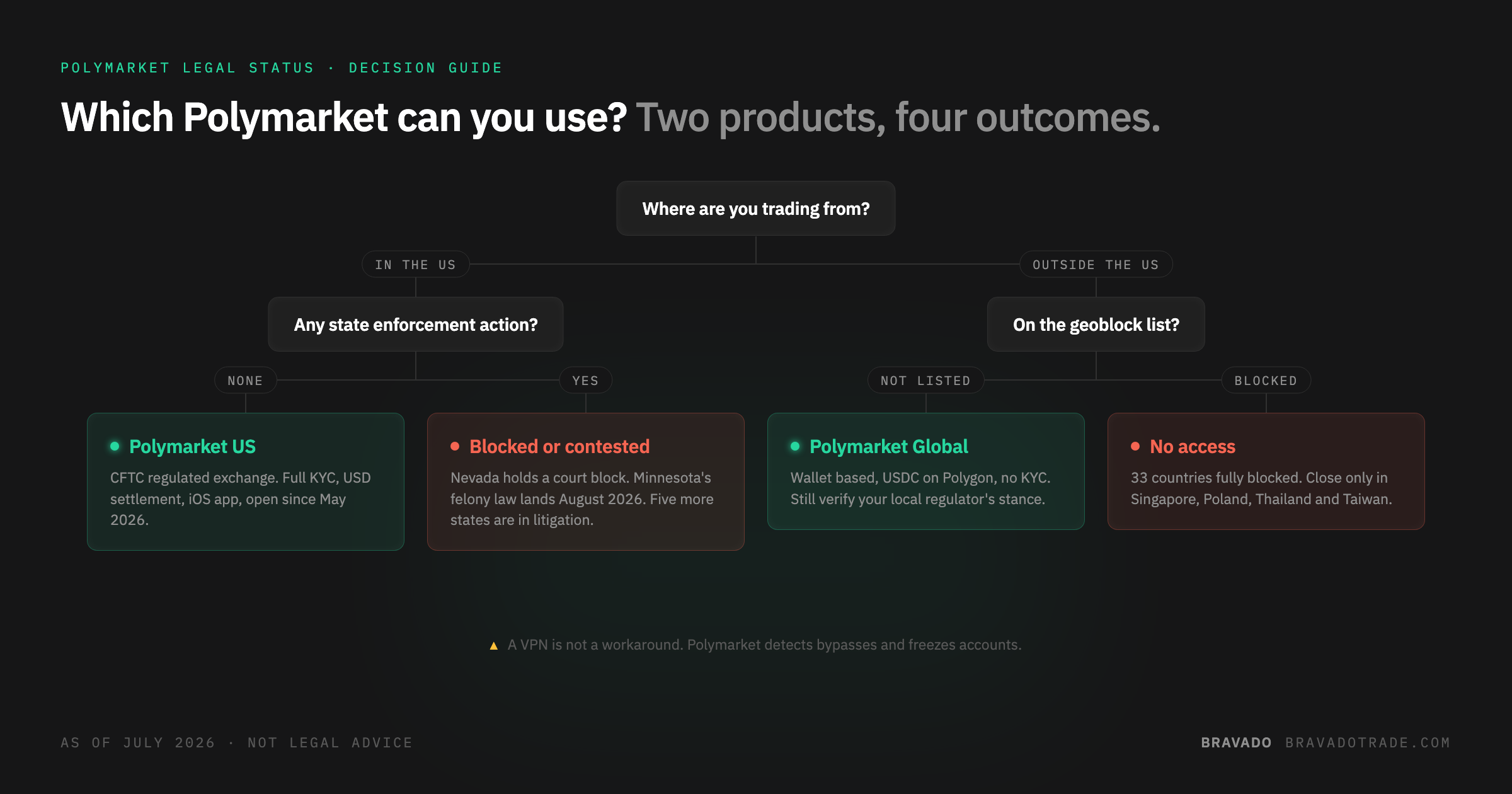
There are two distinct Polymarket products, and they have opposite legal status.
Polymarket Global is the international platform most traders know, built on Polygon, settled in USDC, wallet based, no KYC required. It has been geoblocked for US IP addresses since a 2022 CFTC settlement, and that block remains in place.
Polymarket US, operated by QCX LLC, is a separate CFTC regulated exchange that launched in December 2025 after Polymarket acquired a licensed derivatives exchange. It requires full identity verification, settles in USD, and is the only Polymarket product US residents can legally use today. As of May 2026 it opened to eligible users on iOS without an invite code, though Android and web access are still pending.
So when someone asks "is Polymarket legal in the US," the honest answer is: it depends which Polymarket they mean, and which state they live in.
If you are trading on the international platform, Bravado gives you the professional terminal tooling, on chain data, and audit ready PnL tracking built specifically for it.
How We Got Here: The Federal Timeline
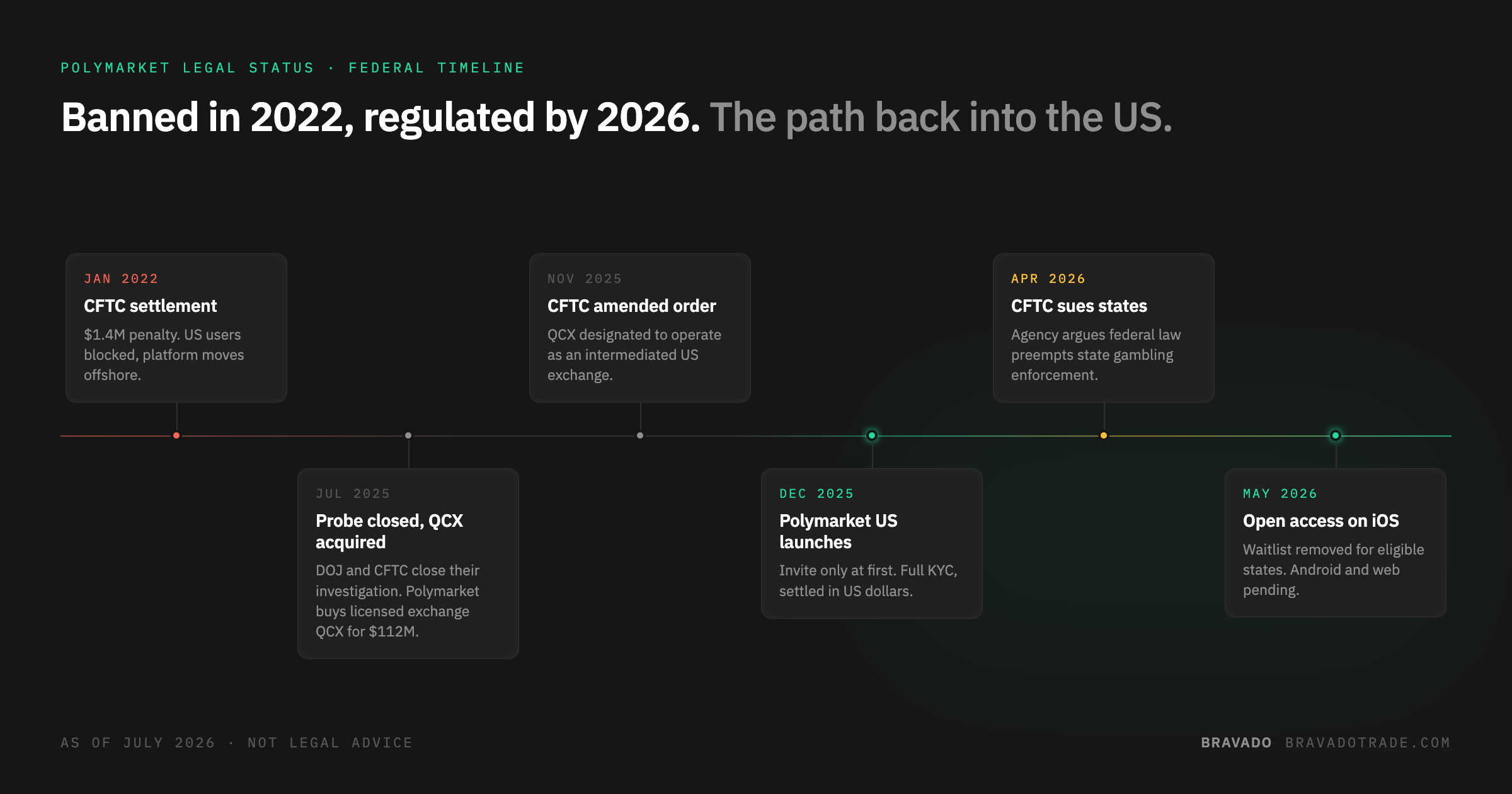
In January 2022, the CFTC ordered Blockratize Inc, the entity operating Polymarket at the time, to pay a $1.4 million penalty for running an unregistered facility for trading event based binary options. Polymarket was required to wind down noncompliant markets and block US users entirely, which is why the international platform still carries geolocation blocks, self certification prompts, and wallet monitoring today.
For nearly three years the platform operated offshore while pressure kept building around the 2024 US election. In July 2025, the Department of Justice and CFTC closed their post election investigation without new charges. That same month, Polymarket acquired QCX LLC and QC Clearing for roughly $112 million, a licensed CFTC regulated derivatives exchange and clearinghouse.
That acquisition mattered because it gave Polymarket a shortcut back into the US market. Rather than applying for new licenses from scratch, it inherited an entity that already had them. In November 2025, the CFTC issued an Amended Order of Designation allowing this new entity to operate as an intermediated US exchange. Polymarket US launched invite only on December 2 to 3, 2025, and removed its waitlist entirely in May 2026.
At the federal level, the regulatory posture through 2026 has been supportive. The CFTC withdrew a prior proposal that would have banned sports and event contracts, published an Advance Notice of Proposed Rulemaking on prediction markets that drew over 3,500 public comments, and in April 2026 the agency went as far as suing several states that had issued cease and desist orders, arguing federal law preempts state gambling enforcement in this area.
Why This Is Still Contested: State vs Federal
Here is the part most explainers skip. Federal approval does not automatically mean every state agrees Polymarket can operate within its borders, and this disagreement is the actual center of the legal debate in 2026.
The core dispute is whether an event contract on a sports outcome or a political race is a financial derivative, which falls under exclusive CFTC jurisdiction, or a wager, which falls under state gambling law. Courts have not landed on one answer.
States where enforcement action has been most aggressive:
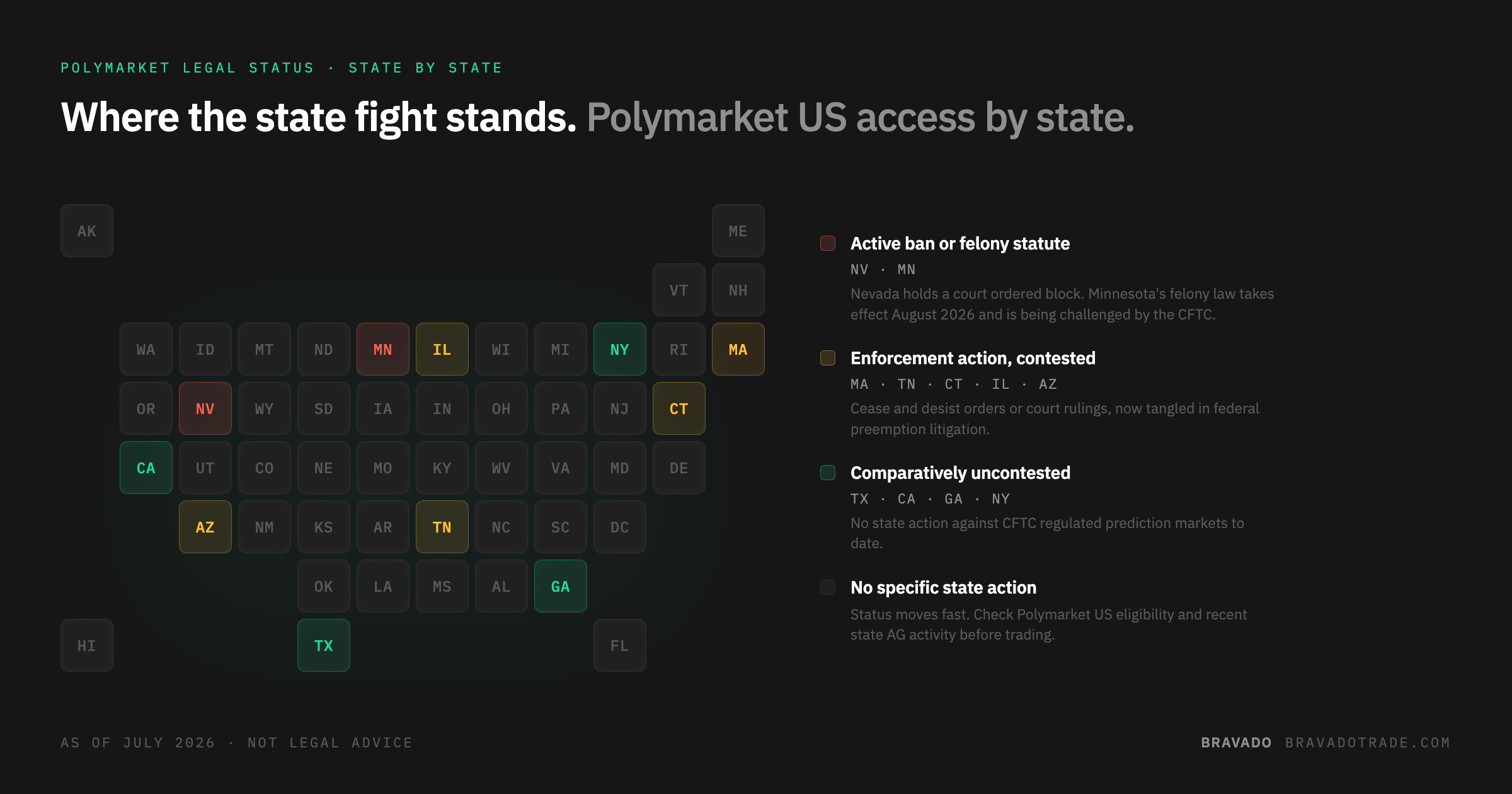
Nevada moved first and hardest. The Nevada Gaming Control Board filed a civil complaint in January 2026, and a judge granted a temporary restraining order barring Polymarket from offering contracts to Nevada residents. This remains the clearest active state level ban.
Massachusetts saw a state court order Kalshi to block state residents in February 2026, a ruling Polymarket has separately challenged in its own suit, arguing federal preemption.
Tennessee, Connecticut, Illinois, and Arizona have all issued cease and desist orders or, in Arizona's case, filed criminal counts. Several of these actions are now the subject of the CFTC's own lawsuit against the states.
Minnesota passed the most severe measure on the books, a law that makes operating a prediction market a felony, effective August 1, 2026. The CFTC is challenging it.
States where access currently looks straightforward:
Texas has no state sports betting industry to conflict with, and officials have not moved against CFTC regulated prediction markets, so access has been comparatively uncontested.
California has no state law specifically barring participation in federally regulated event contracts, though tribal gaming interests have applied political pressure and litigation risk has not fully cleared.
Georgia's gambling statutes target casino gaming and sports wagering specifically, and prediction markets structured as event contracts fall outside that scope.
New York's legal footing rests on the argument that event contracts are financial instruments under CFTC oversight rather than state regulated gambling, though New York's broader financial regulatory posture means this could shift.
If you do not see your state listed, the honest answer is that the picture is moving fast enough that a specific state by state list ages out within weeks. Check Polymarket US's own eligibility page and recent state AG activity before assuming your state's status.
Is Polymarket Gambling?
This is the question underneath almost every other legal question on this list, and there is no settled answer.
The CFTC's position is that event contracts, defined as agreements whose payout depends on the outcome of a future event, are commodity derivatives when they are listed on a registered exchange under the Commodity Exchange Act. Under that framework, betting on whether a particular bill passes or an economic indicator crosses a threshold is treated the same way as any other regulated derivative.
State gambling regulators disagree, arguing that a contract paying out based on a sports score is functionally identical to a sports bet regardless of what federal statute it is filed under. Several state court rulings, most notably the injunction against Kalshi in Massachusetts, have sided with that view. The unresolved legal question, now the subject of active federal litigation against multiple states, is whether the Commodity Exchange Act preempts state gambling law entirely once a platform is CFTC registered. Until a higher court or Congress resolves that question, both interpretations are being actively litigated at the same time.
This is exactly why institutional players entering the space care so much about clean, auditable data. Whichever way the classification question eventually falls, having transaction hash level PnL and position records matters for compliance either way. Bravado's data infrastructure was built around that need, with an on chain pipeline auditable down to the individual Polygon transaction. You can read more about that approach in our neg-risk accounting deep dive.
Can You Use a VPN?
For the international Polymarket Global platform, some traders still attempt to bypass the geoblock using a VPN. This carries real risk beyond a simple terms of service violation. Polymarket uses several detection layers including browser fingerprinting, WebRTC leak checks, and on chain wallet analysis tied to prior US activity, and accounts caught this way have been frozen. Because using a VPN to access a geoblocked financial platform violates the platform's terms, users in that position also have no recourse if a dispute arises, and profits may still be taxable as income even though the access itself was unauthorized.
With Polymarket US now open to eligible states on iOS, the practical need for a VPN workaround has largely disappeared for US based retail users. The remaining question is not how to get around the block but whether your state currently allows the regulated product to operate.
Where Polymarket Stands Internationally
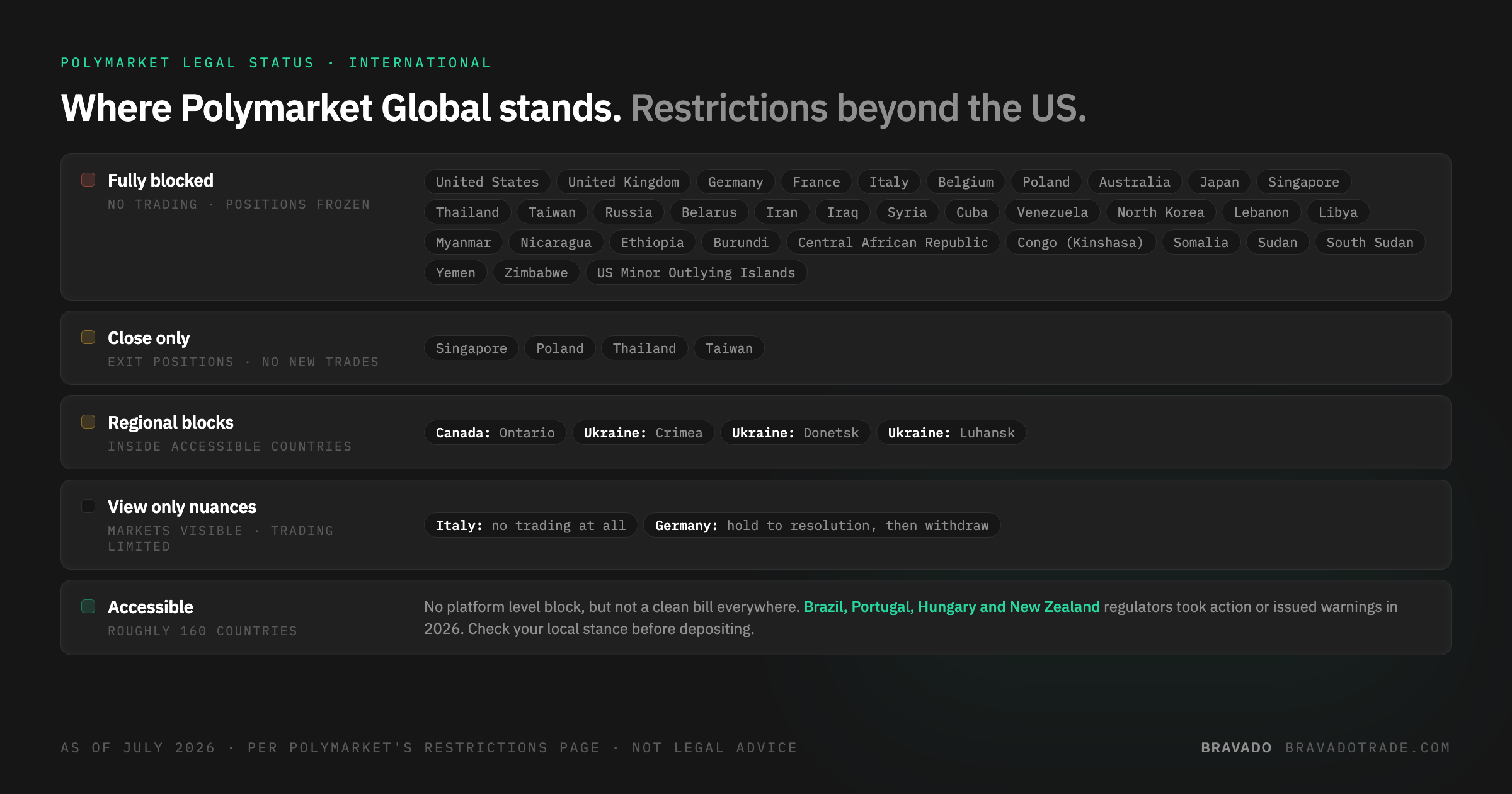
Beyond the US, Polymarket's international platform has faced a growing list of restrictions, and third party lists on this topic vary quite a bit depending on when they were written. The most reliable source is Polymarket's own geographic restrictions page, which it updates directly. As of mid 2026, it lists the following.
Countries where Polymarket is fully blocked (no trading, no new orders, existing positions cannot be closed):
Australia, Belgium, Belarus, Burundi, Central African Republic, Congo (Kinshasa), Cuba, Germany, Ethiopia, France, United Kingdom, Iran, Iraq, Italy, Japan, North Korea, Lebanon, Libya, Myanmar, Nicaragua, Poland, Russia, Singapore, Somalia, South Sudan, Sudan, Syria, Thailand, Taiwan, United States Minor Outlying Islands, the United States, Venezuela, Yemen, and Zimbabwe, 33 countries in total. This list blends two different categories: OFAC sanctioned jurisdictions (Cuba, Iran, North Korea, Russia, Syria, Venezuela, and similar) and countries whose financial or gambling regulators have separately required Polymarket to block access (the EU members and UK on this list, Australia, Japan, Singapore, Thailand, Taiwan).
Specific blocked regions within otherwise accessible countries:
Ontario, Canada
Crimea, Donetsk, and Luhansk, Ukraine
Countries with "close only" status, meaning existing positions can be closed out but no new trades can be opened:
Singapore, Poland, Thailand, and Taiwan
A note on Italy and Germany specifically: both allow users to view markets and data, but Italy restricts trading entirely and Germany prohibits new trading while still allowing existing positions to be held to resolution and withdrawn afterward.
Everywhere else, meaning the roughly 160 remaining countries not named above, Polymarket is accessible without a platform level block, though that does not mean every one of those countries has settled the underlying legal question. Local financial and gambling regulations still vary, and several jurisdictions not yet on Polymarket's own blocklist, including Brazil, Portugal, Hungary, and New Zealand, have separately taken regulatory action or issued warnings against prediction market platforms in 2026, so accessible is not the same guarantee as fully resolved. If you are trading from a country not explicitly named as blocked above, it is still worth checking your local regulator's current stance before depositing meaningful funds, since this list is one of the fastest moving parts of the entire prediction market industry.
Frequently Asked Questions
Is Polymarket legal in the US? Polymarket US, the CFTC regulated exchange, is legal federally and is currently open to eligible users. Polymarket Global, the original international platform, remains geoblocked for US IP addresses under the 2022 CFTC settlement.
Can you trade on Polymarket in the USA? Yes, through Polymarket US, which requires full identity verification and settles in USD. The original crypto native platform is not accessible from US IP addresses.
Is Polymarket legal in Texas? Current enforcement activity in Texas has not targeted CFTC regulated prediction markets, and access has been comparatively uncontested compared to states like Nevada or Minnesota.
Is Polymarket legal in California? California has no state law specifically prohibiting participation in federally regulated event contracts, though tribal gaming groups have pushed back politically and legally.
What countries is Polymarket legal in? The rules vary widely by country and change frequently. Polymarket Global has been blocked or restricted in more than a dozen countries since early 2025, including Brazil, the Netherlands, Portugal, and New Zealand, alongside its long standing US geoblock.
Is Polymarket gambling? That is the unresolved legal question at the center of ongoing litigation. The CFTC classifies event contracts as financial derivatives. Several states argue they function as gambling. Courts have issued conflicting rulings, and no final resolution exists as of mid 2026.
Is Polymarket publicly traded or is Polymarket a legit company? Polymarket is privately held. Its legitimacy question is separate from its legal status: the platform has drawn institutional attention (including data partnerships and its CFTC regulated US entity) while also facing scrutiny over insider trading concerns and, in some cases, promotional practices around market manipulation, which have been reported on by outlets including the Wall Street Journal.
Trading on Polymarket? Bring Professional Tooling
Regardless of where the legal picture lands in your state or country, if you're actively trading on Polymarket you need infrastructure built for it specifically, not a generic crypto dashboard. Bravado is a professional trading terminal and data platform built exclusively for Polymarket, with orderbook analytics, whale tracking, copy trading, and audit defensible PnL accounting. Check out the Bravado terminal or explore the Trade API and Data API if you're building on top of Polymarket yourself.
This article reflects the public regulatory record as of July 2026. State and federal positions on prediction markets are changing quickly through ongoing litigation, and this is general information rather than legal advice. Always verify your specific state's current status before trading.